Most brands post content. Few brands tell stories. That difference is exactly why some social media accounts get scrolled past in half a second, while others stop people mid-scroll and keep them reading, watching, and commenting.
If you have ever asked "why is my social media engagement so low even though I post consistently," the answer is usually not frequency. It is substance. People do not engage with information for information's sake. They engage with stories, because stories are how humans have always made sense of the world and decided what (and who) to pay attention to.
In this article, we will break down the storytelling techniques that actually move the needle on social media, how to apply them across platforms, and how to measure whether your storytelling is working or just looking nice.
Why Storytelling Works Better Than "Content" on Social Media
Before getting into technique, it is worth understanding why storytelling outperforms generic content marketing.
- Stories create emotional connection. People remember how content made them feel long after they forget the facts in it.
- Stories are inherently shareable. A relatable story gets sent to a friend. A product feature list does not.
- Stories build trust over time. Consistent, authentic narratives make your brand feel like a known entity rather than a faceless account trying to sell something.
- Stories improve retention and watch time, which social platforms reward with more reach. Algorithms on Instagram, TikTok, and LinkedIn are built to prioritize content that keeps people watching or reading, and stories do exactly that.
This is also why "storytelling for social media marketing" and "how to increase social media engagement" are two of the most searched topics for marketers right now. Everyone knows engagement is the currency, but very few teams have a repeatable system for creating stories rather than one-off posts.
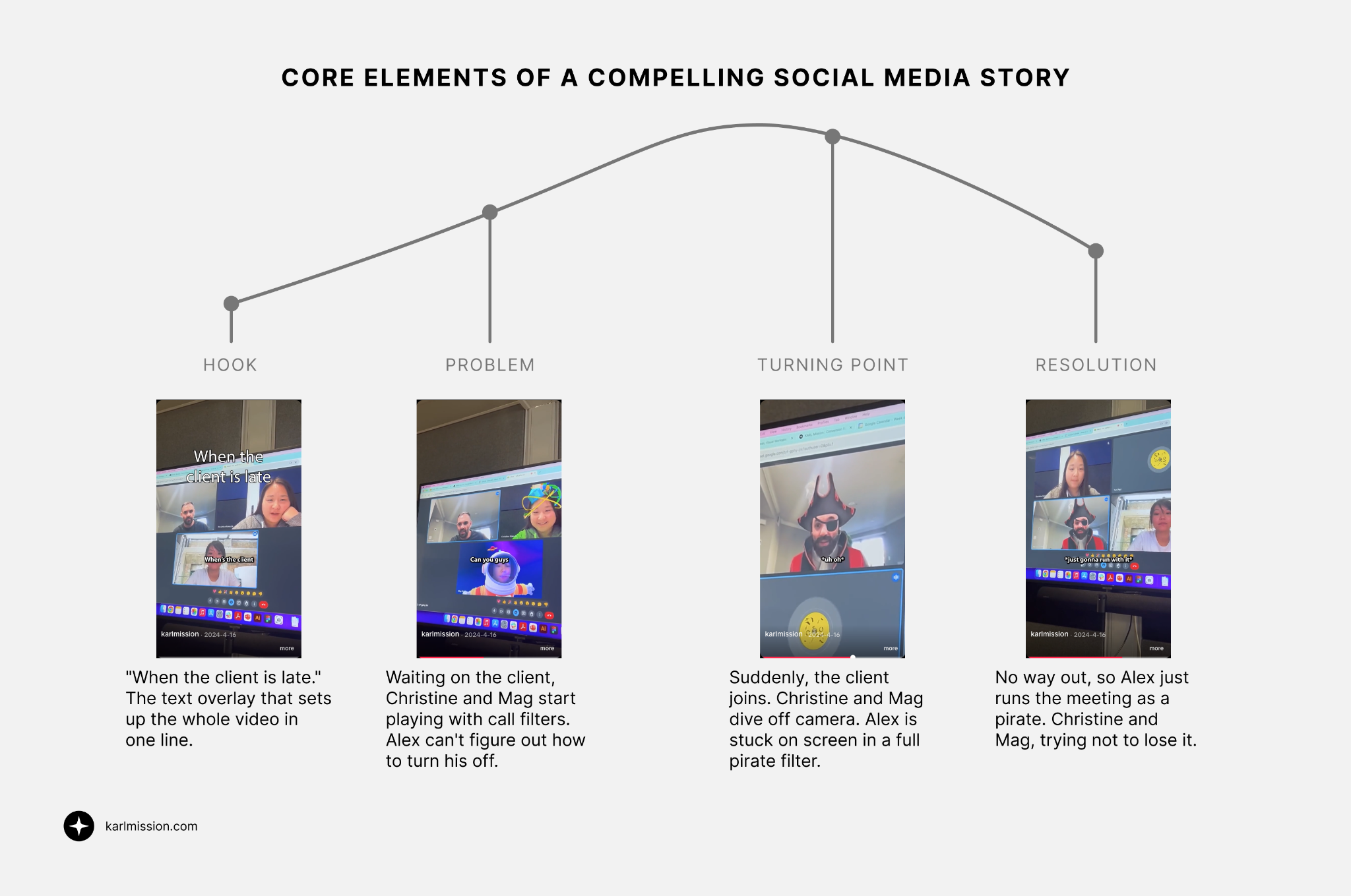
The Core Elements of a Compelling Social Media Story
You do not need to be a novelist to tell a good brand story. You need a handful of narrative building blocks, applied consistently.
1. A Clear Protagonist
Every story needs someone the audience can root for. On social media, this is rarely your brand itself. It is usually:
- A customer
- An employee
- A founder
- Or even the audience member themselves ("you" as the hero of the story)
Brands that center themselves as the hero of every story tend to feel self-promotional. Brands that position the customer as the hero, with the brand as the guide, tend to build stronger long-term loyalty.
2. A Real Problem or Tension
Stories without conflict are not stories, they are announcements. Effective social content usually opens with a relatable problem: a frustration, a mistake, a misconception, or a challenge your audience faces.
For example, instead of "We launched a new feature," try "Here is the mistake we kept seeing our clients make, and how we fixed it."
3. A Turning Point
This is where your product, service, insight, or advice enters the story, not as a sales pitch, but as the resolution to the tension you set up.
4. A Resolution That Ties Back to Value
End with the outcome. What changed? What was learned? What can the audience now do differently? This is also where you naturally reinforce your expertise without sounding like an ad.
5. A Hook in the First Three Seconds (or First Line)
On every platform, the opening line or first few seconds of a video determine whether people keep engaging. Strong hooks include:
- A bold, specific claim ("Most companies lose 60% of their site visitors before they ever see a call to action.")
- A question that mirrors your audience's internal dialogue
- A contrarian statement that challenges a common assumption
Storytelling Techniques That Work Across Platforms
Behind-the-Scenes Storytelling
Showing the process, not just the polished result, builds authenticity. This works especially well on Instagram Stories, TikTok, and LinkedIn, where audiences increasingly favor unpolished, real moments over highly produced content.
Customer Success Stories (Told as Stories, Not Testimonials)
A quote saying "Great service, highly recommend" is not a story. A short narrative following a real customer's before-and-after, with specific numbers and specific struggles, is. This technique doubles as social proof and is one of the most effective ways to support both social engagement and conversion rate optimization efforts on your website.
Serialized Content
Turning one story into a short series (Part 1, Part 2, Part 3) trains your audience to come back, which directly improves follower retention and repeat engagement. This works particularly well for case studies, "building in public" content, and educational series.
Data-Driven Storytelling
Numbers alone are boring. Numbers wrapped in a narrative are compelling. Instead of "Our client's conversion rate increased by 34%," frame it as: "Six weeks ago, this client was losing nearly a third of their checkout traffic. Here is exactly what we changed."
User-Generated Storytelling
Reposting and framing stories from your actual customers or community members reduces production effort while increasing authenticity, since audiences trust peer stories more than brand-produced ones.
Platform-Specific Considerations
Storytelling principles stay the same, but execution should adapt:
- Instagram and TikTok: Favor short, visual, fast-paced storytelling. Hook within the first 1-2 seconds. Use captions as a secondary storytelling layer for accessibility and algorithm context.
- LinkedIn: Favor personal, first-person narratives, especially from founders or team members. Longer-form storytelling performs well here if the hook is strong.
- Facebook: Works well for community and customer-story formats, particularly for local or service-based businesses.
- X (formerly Twitter): Favor concise, thread-based storytelling, where each post builds on the last.

Common Mistakes That Kill Social Media Storytelling
- Starting with the brand instead of the audience. If your first line is about you, most people scroll past.
- No clear point. A story with no resolution or takeaway just feels like rambling.
- Overproduced content that feels inauthentic. Especially on TikTok and Instagram Reels, overly polished content often underperforms raw, honest storytelling.
- Ignoring the data. Posting stories without reviewing which formats, hooks, or topics actually drive engagement, saves, shares, and click-throughs means you are guessing instead of improving.
This last point matters more than most teams realize. Storytelling is not just a creative exercise, it is a testable, measurable part of your marketing strategy. Reviewing performance through proper data and web analytics lets you see which stories are actually driving engagement and, further down the funnel, which are contributing to conversions on your website.
How to Know If Your Storytelling Is Working
Engagement metrics alone (likes, comments) only tell part of the story. To understand true impact, track:
- Watch time and scroll depth for video and long-form posts
- Save and share rates, which indicate genuine resonance rather than passive engagement
- Click-through rate to your website or landing pages
- On-site behavior after the click, including bounce rate and time on page
- Conversion rate for anyone who lands on your site from a social story, whether that is a form fill, sign-up, or consultation booking
This is where social media storytelling and conversion rate optimization intersect. A great story can bring the right audience to your site, but if the landing experience does not continue that narrative, you lose the momentum you just built. Auditing that full journey, from the hook on social media to the on-site experience, is one of the most overlooked opportunities for growth.
Building a Repeatable Storytelling System
The brands that consistently perform well on social media are not relying on inspiration alone. They have a system:
- A running list of real customer problems, wins, and behind-the-scenes moments to draw from
- A simple story template (hook, problem, turning point, resolution, CTA) applied to every piece of content
- A content calendar that balances educational, entertaining, and promotional storytelling
- Regular review of performance data to refine hooks, formats, and topics
- Clear alignment between social storytelling and the on-site experience it points to
Getting this right consistently is where many internal marketing teams get stuck, not because they lack good stories, but because they lack the structured process and testing to know what actually works for their specific audience.
Final Thoughts
Storytelling is not a soft skill bolted onto social media marketing. It is one of the most measurable, testable levers you have for driving real engagement and, ultimately, real business results. The brands that treat it as a system rather than a once-in-a-while creative burst are the ones seeing consistent growth in followers, engagement, and site traffic.
If you want help building a social media storytelling strategy that is backed by data and tied directly to your website's conversion goals, we can help you connect the dots between the story and the sale.
Book a Free Consultation with our team to review your current social media strategy and find out where storytelling could be driving more engagement, traffic, and conversions for your business.
Book a Free Website Consultation
Discover quick wins for your digital strategy. 100% guaranteed.