Conversion rate optimization is not about guesswork. It is about making better decisions, faster, based on real user behavior. The right tools help you uncover insights, test ideas, and implement improvements that directly impact revenue.
In this guide, we break down the essential CRO tools across research, testing, analytics, and execution so you can build a stack that actually drives results.
Why CRO Tools Matter
Most websites do not have a traffic problem. They have a conversion problem.
You can spend thousands driving more visitors through SEO, paid media, or social, but if your website is not converting, you are just scaling inefficiency. More traffic into a broken experience does not create growth. It amplifies waste.
This is where CRO tools become critical. They shift your focus from guessing what might work to understanding what actually drives results.
CRO tools help you:
1. Understand how users actually behave on your site
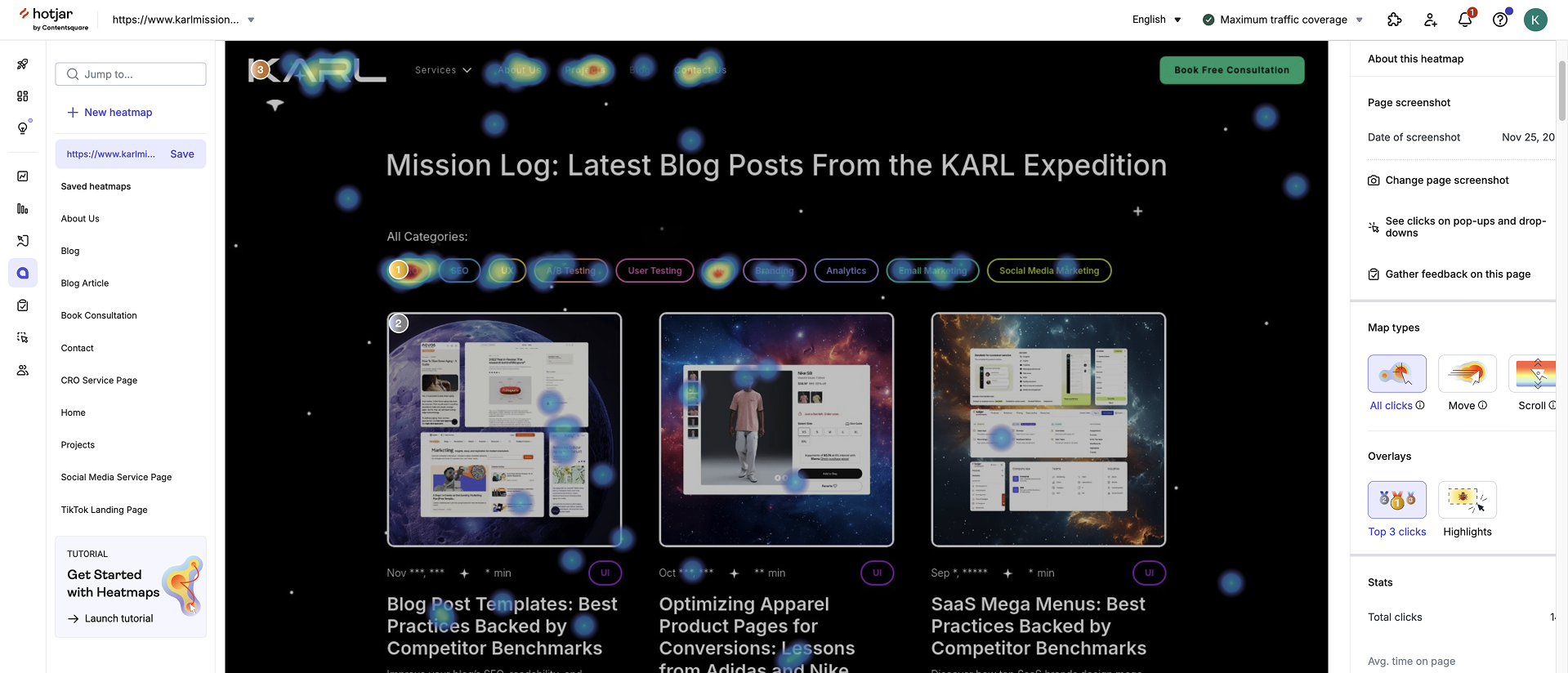
Not how you think they behave. Not how your team assumes they behave. Tools like Google Analytics and Hotjar reveal real patterns, from where users come from to how they navigate, where they hesitate, and where they leave. This is the foundation of any meaningful optimization work.
2. Identify friction points and drop-offs
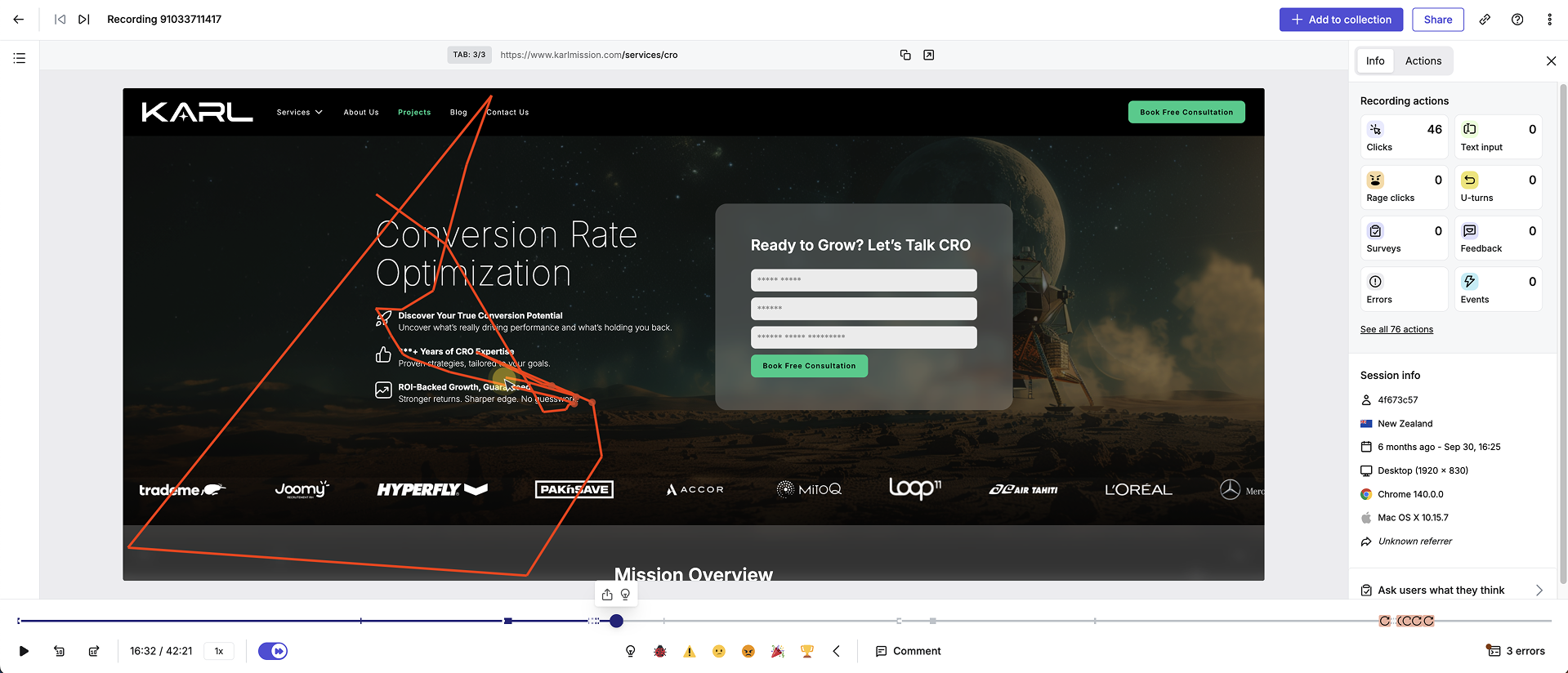
Every conversion funnel has leaks. The problem is most teams do not know where they are. CRO tools help you pinpoint exactly where users are getting stuck, whether it is a confusing layout, weak messaging, slow load times, or a poorly designed form. Instead of redesigning entire pages blindly, you can focus on fixing what actually matters.
3. Test improvements instead of relying on opinions
Without testing, decisions are driven by the loudest voice in the room. With tools like Optimizely or VWO, you can validate ideas through controlled experiments. This removes bias and gives you confidence that changes will improve performance before rolling them out fully.
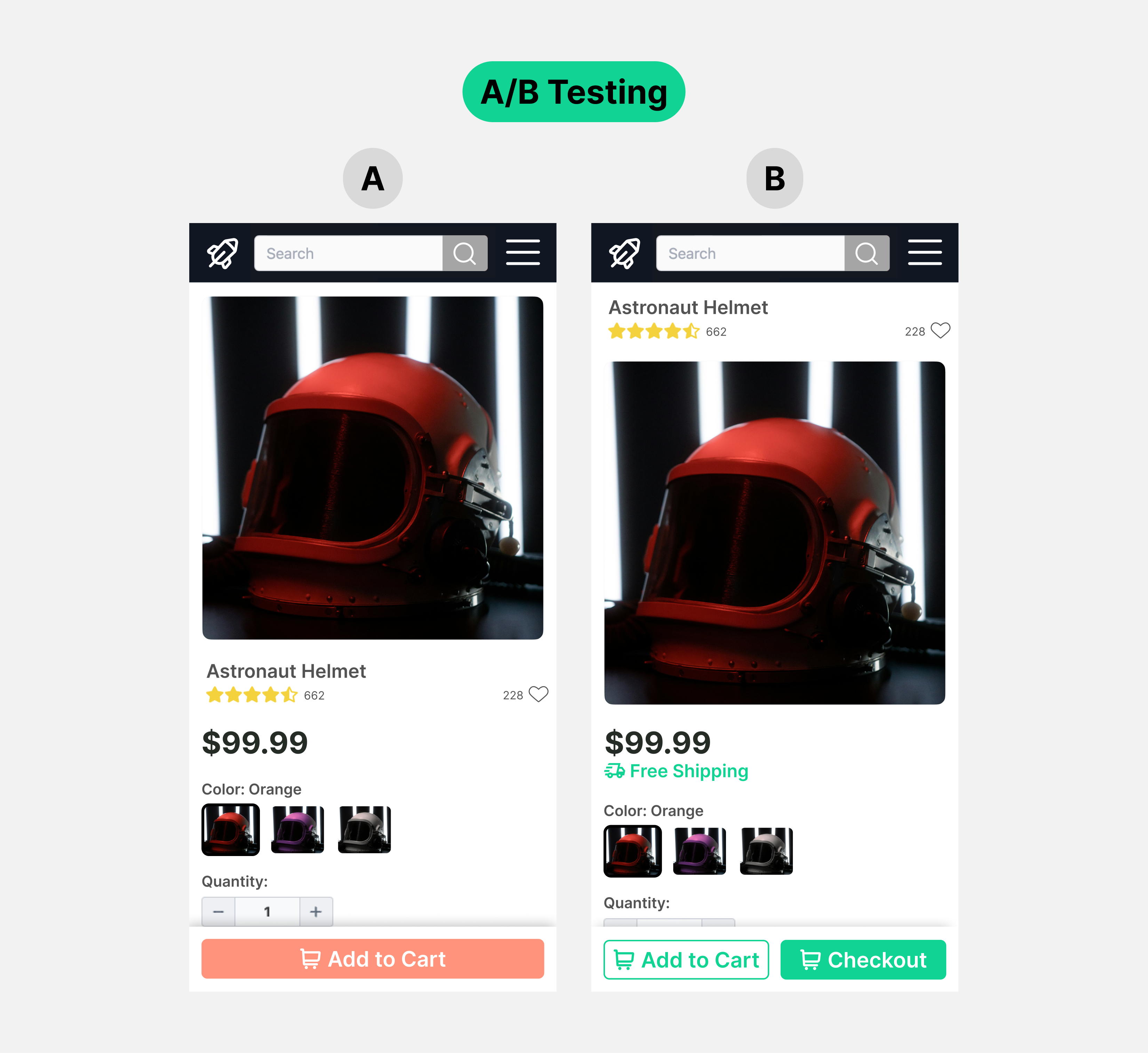
A/B testing comparison of two mobile eCommerce product pages for an astronaut helmet. Version A shows a standard layout with product image, rating, price ($99.99), color options, quantity selector, and a single “Add to Cart” button. Version B includes additional elements such as a product title at the top, “Free Shipping” label, and two CTAs (“Add to Cart” and “Checkout”), highlighting differences in layout and conversion-focused design.
4. Continuously optimize performance over time
CRO is not a one-time project. User behavior changes. Markets shift. What works today might underperform tomorrow. A strong tool stack allows you to run ongoing experiments, learn from data, and keep improving your conversion rate month after month.
If you are serious about growth, your tools should support a structured experimentation process, not just surface-level metrics.
Because at the end of the day, CRO is not about tools. It is about building a system that consistently turns insights into measurable business impact.
From Insights to Action: Building Your CRO Stack
Understanding why CRO tools matter is one thing. Knowing how to actually use them together is where most teams fall short.
A common mistake is treating these tools as standalone solutions. Installing Google Analytics or Hotjar does not improve conversions on its own. The value comes from how you connect insights, testing, and execution into a repeatable process.
A strong CRO setup typically follows a simple loop:
- Measure what users are doing
- Analyze where and why they drop off
- Test potential improvements
- Implement what works
- Repeat continuously
Each category of tools plays a specific role in that loop. Some help you uncover problems. Others help you validate solutions. Others help you execute changes faster.
The goal is not to use more tools. It is to use the right tools at the right stage of the process.
Below, we break down the essential CRO tools by category so you can build a stack that supports real, ongoing optimization, not just one-off improvements.

1. Analytics Tools: Understand What is Happening
Before you optimize anything, you need clarity on what users are doing.
Key Tools:
What they are good for:
- Traffic sources and user acquisition
- Conversion funnels and drop-off points
- Page performance and engagement metrics
Limitations:
Analytics tools tell you what is happening, not why it is happening. You will need additional tools to go deeper.

2. Behavior Analytics Tools: Understand Why Users Drop Off
This is where CRO starts to get interesting.
Key Tools:
What they are good for:
- Heatmaps to see where users click and scroll
- Session recordings to observe real user behavior
- On-site surveys for qualitative feedback
When to use:
If you are asking questions like:
- Why are users not clicking this CTA?
- Why are they abandoning this page?
- Why is engagement low?
These tools give you direct visibility into user behavior.

3. A/B Testing Tools: Validate What Works
Once you have insights, you need to test your ideas.
Key Tools:
What they are good for:
- Running A/B and multivariate tests
- Validating design, copy, and UX changes
- Measuring impact on conversion rates
Important note:
Many teams skip this step and go straight to implementation. That is a mistake. Testing reduces risk and ensures you are making improvements based on data, not opinions.

4. User Testing Tools: Hear from Real Users
Sometimes the fastest way to find problems is to ask real people.
Key Tools:
What they are good for:
- Watching users complete tasks on your site
- Identifying usability issues
- Gathering qualitative insights at scale
Best use case:
Use this early in the process to uncover friction you would never see in analytics.

5. Form Optimization Tools: Fix One of the Biggest Drop-Off Points
Forms are often the highest friction point on a website.
Key Tools:
What they are good for:
- Improving form UX and completion rates
- Reducing friction with better design and logic
- Tracking where users abandon forms
Quick win:
Shorter forms and better microcopy often lead to immediate conversion lifts.
6. Personalization Tools: Increase Relevance
Not all users should see the same experience.
Key Tools:
What they are good for:
- Tailoring content based on user behavior or segments
- Creating targeted landing page experiences
- Increasing relevance for different audiences
When to use:
Once you have enough traffic and data to justify segmentation.

7. Landing Page & UX Tools: Execute Faster
CRO is not just about insights. Execution speed matters.
Key Tools:
What they are good for:
- Rapid prototyping and design iteration
- Building high-converting landing pages
- Reducing dependency on development teams

8. Experimentation and Data Tools: Scale Your CRO Program
As you mature, you need better infrastructure.
Key Tools:
What they are good for:
- Managing tracking and events
- Connecting data across platforms
- Building dashboards for decision-making
How to Choose the Right CRO Tools
Do not fall into the trap of stacking tools without a strategy.
Instead, focus on:
- Your current maturity level
- Your traffic volume
- Your internal resources
- Your ability to actually act on insights
A simple but effective stack for most businesses:
- Analytics: Google Analytics
- Behavior: Hotjar or Microsoft Clarity
- Testing: VWO or Optimizely
- UX: Figma + Webflow
That is enough to start generating meaningful results.
Common Mistakes to Avoid
- Using tools without a clear CRO process
- Collecting data but not acting on it
- Running tests without strong hypotheses
- Overcomplicating your stack too early
Tools do not drive results. How you use them does.
Final Thoughts
CRO is not about having more tools. It is about using the right tools in the right way.
The best-performing teams:
- Focus on user behavior, not assumptions
- Prioritize high-impact tests
- Continuously iterate and learn
If your website is not converting, the answer is almost always in your data. You just need the right tools to uncover it.
Want Help Optimizing Your Conversion Rates?
If you are unsure which tools to use or how to build a CRO process that actually drives revenue, we can help.
We work with businesses to:
- Identify conversion bottlenecks
- Design and run high-impact experiments
- Improve UX and performance across the funnel
👉 Book a free consultation and let’s turn your traffic into measurable growth.
Book a Free Website Consultation
Discover quick wins for your digital strategy. 100% guaranteed.